
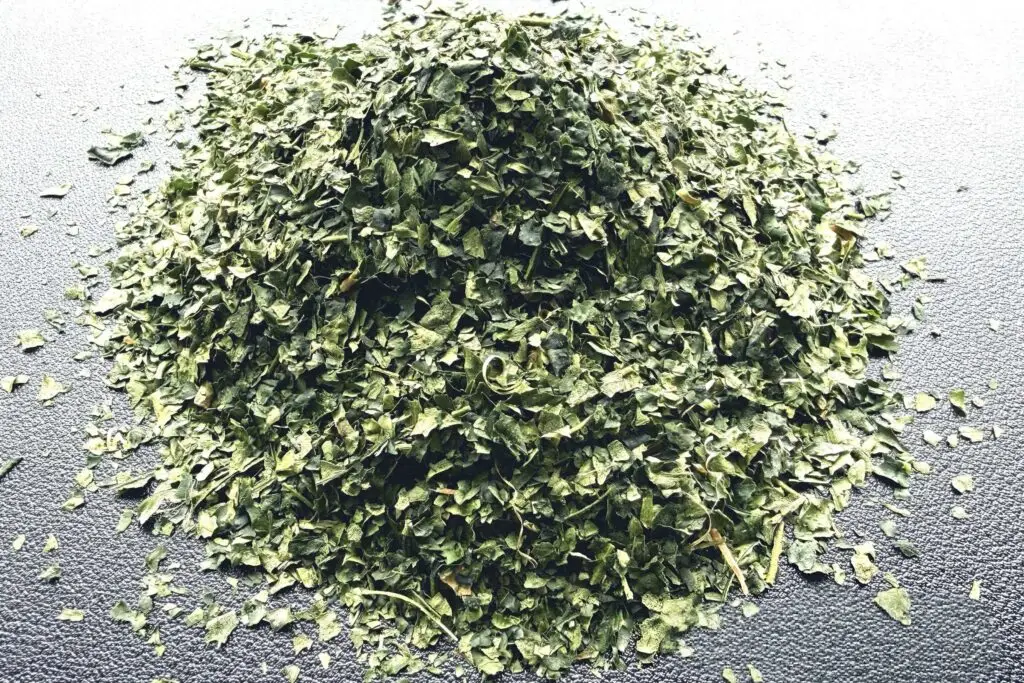
Tencha (碾茶) is the raw material of matcha—essentially, the tea leaves before they are ground into powder.
Only when Tencha is ground by a stone mill or a ball mill and sieved to a particle diameter of D60 ≤ 18 microns does it officially become the Matcha we know and love.
1. The Cultivation and Process
The raw material for Tencha consists of fresh tea leaves that have undergone a shading process.
- Maturity: The leaves require a certain level of maturity, typically harvested as “one bud and five leaves.”
- Shading: The shading process usually begins when the tea plant has “one bud and one to two leaves.” Nowadays, black fiber nets are commonly used to cover the plants.
- Processing: Since the harvested fresh leaves are relatively large, they must undergo leaf cutting, followed by steam fixation (steaming), cooling, and drying.
- Destemming (Key Step): The most critical step is the separation of stems and leaves (veins and stalks). The higher the grade of Tencha, the more thoroughly the stems and veins have been removed, leaving only the purest leaf flesh.
2. The Etymology: Why is it called “Nian Cha”?
The name “Nian Cha” (碾茶) comes from the Chinese character “Nian” (碾), which means to crush or grind with a roller.
Before the Ming Dynasty, tea was primarily produced in the form of Tea Cakes. To drink it, one had to pry a piece off the cake and grind it into powder using a stone mill or stone roller. Hence, the name reflects the ancient method of preparing tea for consumption.
3. Factors Determining Quality
The quality of Tencha is primarily determined by three factors: Tea Cultivar, Harvest Time, and Processing Craft.
- Tea Cultivars: Common cultivars used for high-quality Tencha include:
- Japanese Varieties: Yabukita (薮北), Okumidori (奥绿).
- Chinese Varieties: Longjing 43, Fuding Dabaicha (福鼎大白), Jiukeng (鸠坑), Zhongcha 108.
- Why these matters: After shading, these varieties produce high chlorophyll content (resulting in a vibrant green color) and high L-theanine content (providing sweetness and umami).
- Harvest Time: Like other premium teas, the earlier the harvest, the better the quality—and naturally, the higher the price.
- Processing Craft: This depends on the equipment and specific parameter settings. Every tea factory has its own unique “signature” or characteristic based on how they process the Tencha.