
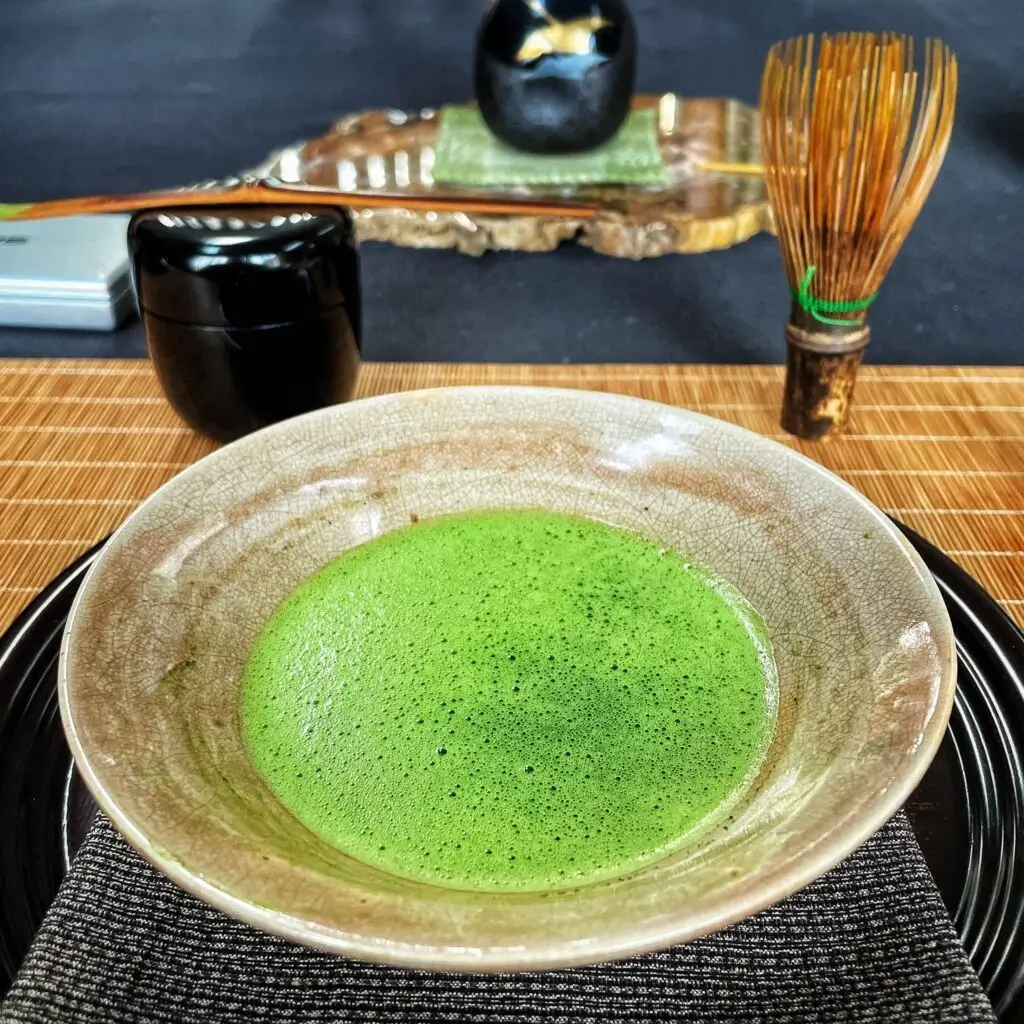
Matcha is more than just a refreshing green drink; it carries the weight of history and culture for two nations. While Chinese and Japanese matcha share a common ancestry, they have evolved distinct characteristics over the centuries.
Today, let’s explore the differences between Chinese and Japanese matcha and discover the unique charm of each.
1. Historical Origins: Ancient Traditions, Different Trajectories
Chinese Matcha
The history of matcha in China can be traced back to the Wei and Jin dynasties. By the Sui and Tang dynasties, people began grinding steamed tea cakes into “Mo Cha” (powdered tea) and mixing it with hot water.
The Song Dynasty marked the golden age of “Mo Cha.” The craftsmanship of tea cakes was complex, and the tea-drinking process became highly ritualized, with techniques like “Dian Cha” (whisking tea) and “Fen Cha” (tea art) shining brightly. However, by the mid-to-late Ming Dynasty, this form of powdered tea gradually declined in favor of loose-leaf brewing.
Japanese Matcha
In the 9th century, matcha was introduced to Japan by envoys to the Tang Dynasty. Later, through the study and improvement by Japanese monks like Eisai, a systematic tea ceremony gradually developed in Japan.
Notably, during the Muromachi period, tea farmers in Uji invented the “shade-grown cultivation method.” This significantly improved the quality of matcha and laid the foundation for the unique flavor profile of Japanese matcha we know today.
2. Raw Materials: Subtle Differences at the Source
Chinese Matcha
- Tea Cultivars: The raw materials come from a rich variety of tea trees. Different regions select varieties suitable for their local natural conditions and planting traditions. For example, Zhejiang and Guizhou provinces each use their own distinct local tea trees for matcha production.
- Cultivation Methods: In recent years, Chinese matcha production areas have begun to adopt shading methods similar to those in Japan. For instance, matcha bases in Jiangkou County, Guizhou, use shading nets to cover tea trees. This reduces light intensity and increases chlorophyll content, though specific operational details and covering materials differ slightly from Japanese practices.
Japanese Matcha
- Tea Cultivars: The main raw materials come from tea tree varieties that have been specially bred and selected over long periods. In regions like Uji, specific cultivars adapted to the local soil and climate are used to produce high-quality matcha.
- Cultivation Methods: Japan strictly employs the shade-grown method. About 20 days before tea picking, tea trees are shaded using reed screens, straw mats, or black plastic mesh, requiring a high shading rate. This maximizes the retention of components like theanine while reducing the formation of bitter catechins, resulting in bright green leaves and the formation of the unique “Oika” (covering aroma).
3. Production Craft: Different Paths of Ingenuity
The “Kill-Green” Process (Steaming)
- Chinese Matcha: Mostly uses steam fixation. High-temperature steam destroys and passivates the activity of oxidase in fresh leaves, inhibiting the enzymatic oxidation of tea polyphenols. This extends shelf life while imparting a special aroma and taste to the tea.
- Japanese Matcha: Also primarily uses steam fixation. This is key to maintaining the tea’s fresh green color and natural nutritional components, shaping its distinct flavor profile.
Grinding Technology
- Chinese Matcha: Modern grinding technology is widely used, including ball mills, continuous ball mills, and air jet pulverizers. These advanced technologies can grind matcha to an extremely fine powder, reaching up to around 6000 mesh.
- Japanese Matcha: Traditionally, stone mills are used for grinding. Although the speed is slower, the low temperature helps better preserve the nutritional components and flavor. However, some companies are now adopting mechanical grinding to improve efficiency.
Conclusion
Although Chinese matcha and Japanese matcha are inextricably linked, they have developed their own unique styles. Whether it is the rich diversity of Chinese matcha or the refined tradition of Japanese matcha, both are worthy of our appreciation. They are both bright pearls in the treasury of tea culture.